According to AOL's report, in May 2026, a Florida corporation that had owned a modest bungalow on Chilean Avenue for nearly 34 years stood before the Palm Beach Town Council and objected, through counsel, to having the house declared a landmark. The vote opened tied at 2-2. Mayor Danielle Moore broke the deadlock, Council Member Julie Araskog was absent, and the final tally landed 3-2 in favor of designation. The owner's objection did not change the outcome. Attorney Maura Ziska represented the owner at the hearing.
For anyone shopping for an older home on the island, or weighing a serious renovation of one, the Chilean Avenue case illustrates how landmark designation can affect a property's review process. A property may be designated over an owner's objection, and designation may affect renovation plans, costs, and timing.
How landmark designation works
Under Chapter 54 of the Palm Beach Town Code, adopted in 1979, owner opposition does not prevent a landmark designation from going through. Once a property carries that status, or sits inside one of the town's historic districts, review authority shifts from the Architectural Commission to the Landmarks Preservation Commission, and the standards get more specific. Any exterior change visible from the street needs Landmarks approval, and in some cases interior features do too, whether the designation was welcomed or fought line by line at a public hearing.
A limited exception applies in certain flood-risk circumstances. A 2022 state law allows single-family owners who object to a designation to demolish their home if the property sits in a flood-hazard area and doesn't meet FEMA's flood-elevation standards. It's a real provision, but it applies to a specific flood-risk situation, not to general disagreement with the commission's decision.
Where landmark and historic-district protections apply
This isn't a one-house anomaly. The town's own count puts more than 328 landmark properties, sites, and vistas under protection, and that number sits on top of entire historic districts covering parts of Midtown, the Sea Street area, and the El Brillo corridor in the South End, with pockets of overlay protection reaching into the North End as well.
A buyer evaluating an older home in the Estate Section, Midtown, or the South End should consider whether landmark designation or historic-district review may apply. The median list price for a single-family home in Palm Beach reached $992,500 in September 2026, up from $849,000 a year earlier. Buyers planning a renovation should account for applicable review requirements when estimating a budget.
How designation affects renovation work
Review requirements vary by project. Shuster Design says interior work, including kitchen and bath renovations and flooring, generally doesn't require Landmarks approval.
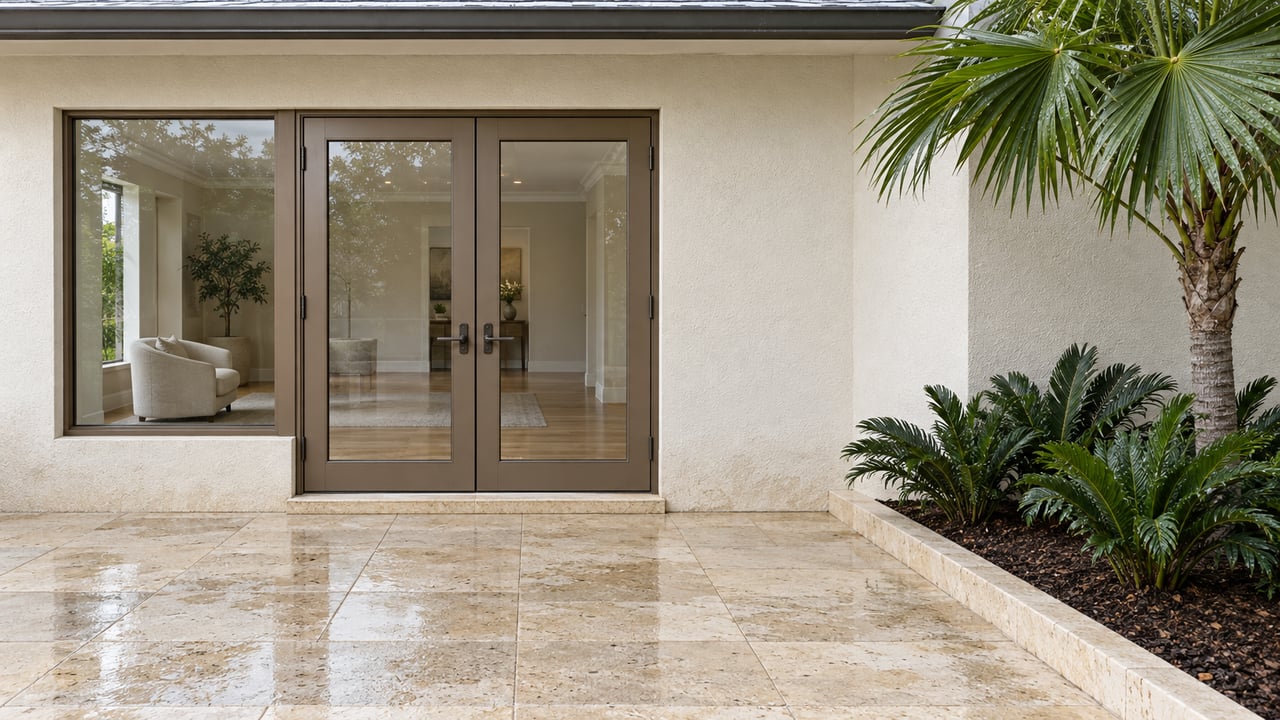
Exterior work, including smaller projects, may require review. A request for new signage, an entry door, and awnings at 259 Worth Avenue was deferred to the commission's June 24, 2026 meeting. Demolition also involves review.
Historic-eligible renovation work in Palm Beach typically runs 15 to 30 percent higher than comparable work on non-historic properties; renovation timelines can also extend beyond standard schedules.
| Renovation scope | Typical total budget | Added review timeline |
|---|---|---|
| Interior-focused update, no exterior change | Starting around $500,000 | Often none beyond standard permitting |
| Comprehensive estate renovation with exterior work | $5 million or more | 2 to 6 months beyond a standard schedule |
Architects working the island regularly build that padding into a proposal before a client asks why.
How the review process applies
This review process applies to properties across price ranges. Todd Michael Glaser, who paid $85 million for Tarpon Island and $18.5 million for the El Brillo Way estate once owned by Jeffrey Epstein before demolishing it, also holds a preservation award from the town's Preservation Foundation for a separate restoration project.
The review queue as of this past summer provides further examples. New single-family applications appeared for addresses including 230 Plantation Road and 418 Seaspray Avenue, alongside a full renovation and landscape redesign at 1066 North Ocean Boulevard. From beach cottages to oceanfront estates, the same process applies.
The one conversation that actually moves the needle
A private sale follows the same overlay rules. Whether a listing is public or off-market, the same review track applies to the same address. What an off-market deal can offer is something more useful than a different rulebook: time. A quiet, pre-application conversation with the Town of Palm Beach Planning, Zoning, and Building Department, held before a contract is signed, lets staff preview a scheme, flag historic-district exposure, and surface likely objections before a buyer is committed. A public listing timeline rarely allows for that step, which is exactly why it's worth building into the process deliberately rather than skipping it because the clock is ticking.
If you're evaluating an older home on the island, the question to ask before writing an offer isn't whether the house is charming. It's which review track it falls into, and whether anyone has had that conversation with the town yet.
FAQ
Does landmark status hurt resale value? It depends on the buyer. Some pay a premium for the guarantee that a neighbor can't tear down an adjacent property for a mismatched design. Others view the material and modification restrictions as a real constraint on future flexibility. Either way, it's a fact to price into the offer, not a surprise to discover during a renovation.
Can a landmarked home ever be demolished? Only in narrow circumstances. The 2022 state law exception applies to single-family owners in flood-hazard areas whose homes don't meet FEMA elevation standards.
Does buying off-market change the rules? No. The overlay rules are identical whether a sale is public or private. What off-market access can offer is time, the chance to have a conversation with Town planning staff before the parcel is under contract, which a public listing timeline typically doesn't allow.
Older homes on this island come with more than a Certificate of Appropriateness process. They come with a specific set of questions worth answering before you're the one signing the contract instead of reviewing it. MC Luxury Living works with buyers across Palm Beach who want that groundwork done early, not discovered mid-renovation. Get your instant home valuation or start a private consultation before your next offer goes in.
This article is general information, not legal, tax or financial advice. Consult a qualified professional about your situation.